Louisiana law requires drivers to properly restrain children under 18 using the restraint system that applies to the child’s age, size, and the manufacturer’s instructions. Children younger than 13 generally must ride in the rear seat when one is available. Understanding exactly which type of seat applies to your child, and how these rules can affect a car accident claim later, matters for every Louisiana parent, grandparent, and caregiver.
At Chaz Roberts Law, we help families throughout Lafayette, Acadiana, and Louisiana understand their rights after a car accident, especially when a child was involved. If your child was injured in a crash, call (337) 504-3202 to speak with our team.
What Are Louisiana's Car Seat Laws?
Louisiana's child restraint requirements are set out under Louisiana Revised Statutes Section 32:295, which establishes age and size-based categories for child restraint systems, along with penalties for noncompliance.
The law's framework continues through children younger than 13, rather than stopping at a specific younger age or weight threshold, so it's worth understanding the full range of requirements rather than relying on outdated shorthand you may have heard elsewhere.
Louisiana Car Seat Requirements by Age and Size
The specific type of restraint required generally depends on a child's age, weight, and height, following the guidelines below as a general overview.
Always follow the specific instructions provided by both your child restraint's manufacturer and your vehicle's manufacturer, since these can vary by product and may be more restrictive than the general legal minimum.
Rear-Facing Car Seats for Children Under 2
Louisiana law requires children under the age of 2 to ride in a rear-facing car seat, unless the child has already exceeded the height or weight limits set by the seat's manufacturer. Never place a rear-facing car seat in the front seat of a vehicle equipped with an active passenger-side airbag.
Forward-Facing Car Seats With Internal Harnesses
Once a child outgrows their rear-facing seat, based on manufacturer limits rather than age alone, they generally transition to a forward-facing seat with an internal harness system, continuing to use this type of seat until they reach the height or weight limits set by that seat's manufacturer.
Louisiana Booster Seat Law for Children Age 4 and Older
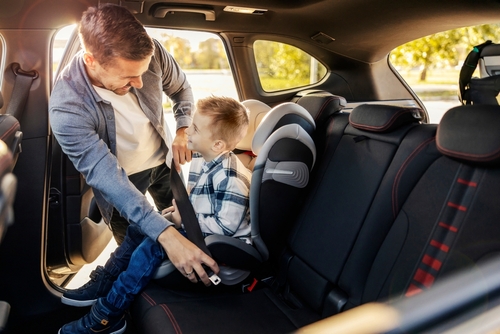
Once a child outgrows a forward-facing harnessed seat, Louisiana law generally requires the use of a booster seat, continuing until the child fits properly in a regular seat belt based on manufacturer guidance for the booster seat being used.
When Can a Child Use a Regular Seat Belt in Louisiana?
Louisiana law does not allow every child to move to an adult safety belt at the same age. A child may use a regular seat belt when the child is at least 9 years old or has outgrown the applicable child restraint or booster seat’s height or weight limits, provided the belt fits properly.
A child should remain in a booster seat until a regular seat belt fits properly, generally meaning the lap belt sits low across the upper thighs and the shoulder belt crosses the chest rather than the neck. Because children reach this point at different ages depending on their individual size, checking proper belt fit matters more than counting birthdays.
Louisiana Front Seat Law for Children
When a vehicle has a rear seat, Louisiana law generally requires children younger than 13 to ride in the rear seat. Never place a rear-facing car seat in front of an active passenger airbag. Review your vehicle manual and the child restraint manufacturer’s instructions to make sure the seat is installed and positioned correctly.
Important Louisiana Car Seat Rules Parents Should Know
A few additional statutory points are worth keeping in mind:
- Always follow both the child restraint manufacturer's instructions and your vehicle manufacturer's instructions, since these can be more specific than the general legal requirements.
- If a child could technically qualify for more than one restraint category based on their age or size, Louisiana law requires using the more protective category.
- Violations of the child restraint law can result in a $100 fine for a first offense, a $250 to $500 fine for a second offense, and a $500 fine plus court costs for a third or subsequent offense.
- The law includes limited exceptions, including certain emergencies, emergency vehicles, and medically necessary situations, though these exceptions are narrow and shouldn't be treated as routine alternatives to proper restraint use.
Why Proper Car Seat Use Matters After a Crash
Using the right car seat or booster seat, installing it correctly, and following the manufacturer’s instructions can make a critical difference in a child’s safety during a collision. Louisiana law also requires drivers to use the restraint system that applies to the child’s age, size, and the manufacturer’s limits.
If another driver causes a crash that injures your child, the fact that a child passenger safety seat was not used generally cannot be treated as comparative negligence or admitted as evidence of negligence in a Louisiana civil case. Every accident is different, however, and families should obtain legal advice based on the facts of the collision, the child’s injuries, and the available insurance coverage.
If your child was injured in a Louisiana collision, Chaz Roberts Law can help you understand your options. Call (337) 504-3202 to discuss your family’s situation.
Should You Replace a Car Seat After an Accident?
After a crash, do not assume a child’s car seat is safe to use simply because it appears undamaged. A collision can damage parts of the seat that may not be visible, including the shell, harness, base, lower anchors, or tether.
The National Highway Traffic Safety Administration recommends replacing a car seat after a moderate or severe crash. A car seat may be reusable after a minor crash only if all five of the following conditions are met:
- The vehicle could be driven away from the crash scene.
- The vehicle door closest to the car seat was not damaged.
- No one in the vehicle was injured.
- The airbags did not deploy.
- The car seat has no visible damage.
Check the car seat manufacturer’s instructions as well. Some manufacturers recommend replacing a seat after any collision, including a minor one. Preserve the seat, photograph it in the vehicle when it is safe to do so, save the manual and proof of purchase if available, and avoid throwing it away before you understand your insurance and legal options.
What to Do If Your Child Is Hurt in a Car Accident
If your child is injured in a car accident, consider these steps:
- Seek emergency medical attention if your child has concerning symptoms, appears injured, or emergency responders recommend evaluation. Even when symptoms are not obvious, consider contacting your child’s pediatrician promptly after the collision for guidance.
- Keep the car seat involved in the accident and photograph it before making any replacement or disposal decision. Check the manufacturer’s crash-replacement guidance, since a seat involved in a moderate or severe crash should be replaced and some manufacturers recommend replacement after any collision.
- Photograph the vehicle, the car seat, and the overall accident scene, if it's safe to do so.
- Document your child's symptoms and any changes in behavior in the days and weeks following the crash.
- Keep copies of all medical records and bills connected to your child's treatment.
- Call Chaz Roberts Law at (337) 504-3202 to discuss your child's case and understand your options.
Speak With a Louisiana Car Accident Lawyer About Your Child's Injuries
An accident involving an injured child raises difficult questions for any parent, from immediate medical concerns to longer-term questions about compensation and accountability. At Chaz Roberts Law, we help families throughout Lafayette, Acadiana, and Louisiana navigate these situations, whether the case involves a child passenger, a question about proper restraint use, or a more serious injury requiring long-term care.
Our team can help you understand how the facts of your child's accident may affect an insurance claim, evaluate what compensation may be available, and guide you through every step of the process.
Contact Chaz Roberts Law at (337) 504-3202 today to talk about your child's case.